When a business decides to invest in digital marketing, one of the first decisions it needs to make is who should handle the work.
Should you hire a freelance digital marketer or work with a digital marketing agency?
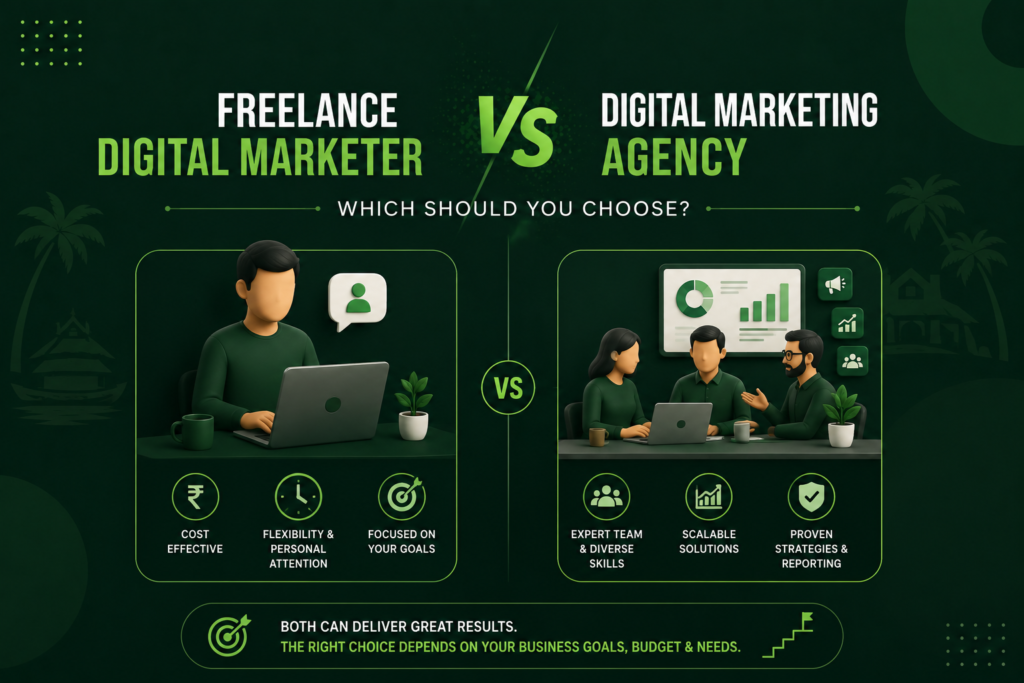
Both options can work well. The right choice depends on the size of the business, the type of marketing support required, budget, communication preferences, and the level of expertise needed.
A freelancer and an agency may offer similar services, but the way they work can be very different. Understanding those differences can help a business choose a setup that fits its current stage instead of simply choosing the option that looks bigger or more affordable.
What Does a Freelance Digital Marketer Do?
A freelance digital marketer is an independent professional who works directly with businesses or clients.
Depending on their expertise, a freelancer may provide services such as:
- Search engine optimisation
- Google Ads
- Meta Ads
- Social media marketing
- Content marketing
- Email marketing
- Website optimisation
- Lead generation
- Digital marketing strategy
One of the main characteristics of working with a freelancer is direct communication.
Instead of communicating through several departments, a business often communicates directly with the person responsible for the marketing work.
This can make discussions faster and allow the marketer to develop a closer understanding of the business.
What Does a Digital Marketing Agency Do?
A digital marketing agency usually operates with a team of professionals.
Different people may be responsible for different areas, such as:
- SEO
- Paid advertising
- Social media
- Graphic design
- Content writing
- Video production
- Web development
- Account management
This team-based structure can be useful for businesses that need several marketing services at the same time.
For example, an established company launching a large campaign may need designers, copywriters, advertising specialists, developers, and strategists working together.
An agency can bring these different skill sets under one organisation.
Freelancer vs Agency: The Key Differences
The biggest differences usually come down to structure, communication, flexibility, cost, and scale.
- Communication
With a freelancer, communication is usually direct.
You can discuss the campaign, ask questions, provide feedback, and explain changes directly to the person handling the work.
With an agency, communication may happen through an account manager or project manager. The actual work may then be handled by different specialists within the team.
Neither system is automatically better.
Some businesses prefer having one direct point of contact, while others prefer a structured team.
- Cost
For many small businesses, budget is an important consideration.
Freelancers generally have lower operational overhead than agencies. They may therefore be able to offer specialised services at a more accessible cost.
Agencies have additional expenses associated with teams, office operations, tools, management, and multiple departments. These costs can be reflected in their pricing.
However, businesses should not choose purely based on the lowest price.
The real question should be:
What value and level of support am I receiving for the amount I am investing?
A cheaper service that does not contribute to business goals may ultimately cost more than a higher-value service.
- Level of Personal Attention
A freelancer working with a limited number of clients may be able to dedicate considerable attention to each account.
This can be particularly valuable for small businesses where the marketer needs to understand the founder’s vision, customer base, products, and business challenges.
Agencies can also provide excellent attention, but the experience depends on the agency’s client load, team structure, and account management process.
If a business values close collaboration and direct involvement, a freelancer may feel more suitable.
- Range of Expertise
This is an area where agencies can have a strong advantage.
A good agency may have specialists across multiple disciplines.
For example, an SEO specialist can work alongside a paid advertising specialist, designer, content writer, and developer.
A freelancer may specialise deeply in one or several areas, but one individual cannot realistically provide the same breadth of resources as a large team.
That does not mean a freelancer cannot deliver comprehensive marketing support.
It simply means businesses should understand what expertise is actually required before making a decision.
- Flexibility
Freelancers can often offer more flexibility in how projects are structured.
A business may be able to start with one specific service, test the results, and expand the scope later.
For a small business that is still figuring out its marketing priorities, this flexibility can be useful.
Agencies may have more established processes and packages. This can be beneficial for businesses that prefer predictable systems and clearly defined workflows.
When Should You Choose a Freelance Digital Marketer?
A freelancer may be a good option if your business:
- Is small or growing
- Needs specialised marketing support
- Has a limited or controlled budget
- Prefers direct communication
- Wants a more personalised approach
- Needs flexibility
- Wants to start with one or two marketing channels
- Needs someone who can work closely with the business owner
For example, a local business may not need a large team to manage its entire digital presence.
It might simply need someone who understands its audience, manages paid campaigns, improves online visibility, creates a practical content strategy, and regularly analyses performance.
In such situations, working directly with an experienced freelancer can make sense.
When Should You Choose a Digital Marketing Agency?
An agency may be more suitable if your business:
- Requires several specialised services
- Is managing large-scale campaigns
- Needs frequent content production
- Requires design and video teams
- Has complex website requirements
- Wants multiple specialists working together
- Is expanding across several markets
- Has a larger marketing budget
For example, a growing e-commerce company may need SEO, paid advertising, social media, creative production, website development, email marketing, and analytics at the same time.
Having a team dedicated to different areas can make an agency a practical choice.
What About Small Businesses?
Small businesses often assume that hiring an agency automatically means getting a better result.
That is not necessarily true.
The right choice depends on what the business actually needs.
If the business requires a complete marketing department with multiple specialists, an agency may make sense.
If it needs focused expertise, personal communication, and flexibility, a freelancer may be a better fit.
The size of the provider should not be the deciding factor.
The fit between the provider and the business should be.
Questions to Ask Before Choosing
Before hiring either a freelancer or an agency, ask a few practical questions.
What exactly do they provide?
Understand which services are included and which are not.
Who will actually handle the work?
This is especially important when working with an agency. The person presenting the strategy may not be the person executing the campaigns.
How will performance be measured?
Ask which metrics will be tracked and how frequently results will be reported.
How do they understand your business?
A good marketer should want to understand your customers, competitors, products, goals, and challenges before recommending a strategy.
Can you see examples of previous work?
Relevant experience can provide useful context, although previous results should never be treated as a guarantee of future performance.
How flexible is the arrangement?
Understand contracts, notice periods, deliverables, communication methods, and what happens if your requirements change.
Don’t Choose Based on Price Alone
Price is important, but it should be considered alongside the potential value of the work.
Suppose one provider charges ₹10,000 per month and another charges ₹25,000.
The cheaper option may seem attractive initially.
But if the more expensive provider has a stronger strategy, better tracking, more relevant expertise, and generates significantly better-quality leads, the actual value may be higher.
Likewise, a higher price does not automatically mean better service.
Businesses should evaluate the entire proposition rather than comparing monthly fees alone.
Can a Business Start With a Freelancer and Move to an Agency Later?
Yes.
Businesses do not have to make a permanent decision from the beginning.
A small business may start with a freelancer when its marketing requirements are relatively focused.
As the business grows, its needs may become more complex. It may then require additional specialists, larger campaigns, more creative production, or advanced technical support.
At that stage, moving to an agency can make sense.
The opposite can also happen. A business may discover that it does not need a large team and prefer the flexibility of working with a specialised freelancer.
The important thing is to reassess the arrangement as the business evolves.
Final Thoughts
There is no universal answer to the question of whether a freelance digital marketer or a digital marketing agency is better.
A freelancer can provide direct communication, flexibility, specialised expertise, and a more personalised working relationship.
An agency can provide a wider team of specialists, structured processes, and the ability to manage more complex marketing requirements.
For a small business, the best choice is usually the one that matches its current goals, budget, marketing requirements, and preferred way of working.
Instead of asking, “Which one is better?”, ask:
“Which one is better for my business right now?”
That shift can make the decision much clearer.
As the business grows, the marketing setup can grow with it. What matters most is having the right expertise, a clear strategy, measurable goals, and a working relationship that helps turn marketing activity into meaningful business results.