“How much does digital marketing cost?”
It is one of the first questions many small business owners ask before investing in online marketing. And understandably so. Whether you run a local shop in Kochi, a service business in Thrissur, a restaurant in Kozhikode, or an online brand serving customers across Kerala, you want to know what you are paying for and what you can realistically expect in return.
The challenge is that there is no single price for digital marketing.
The cost depends on the services required, the size of the business, advertising budget, competition, campaign objectives, content requirements, and how much work is involved in managing the overall strategy.
Instead of looking for one fixed number, it is more useful to understand what contributes to the cost.
What Does Digital Marketing Usually Include?
Digital marketing is not one individual service.
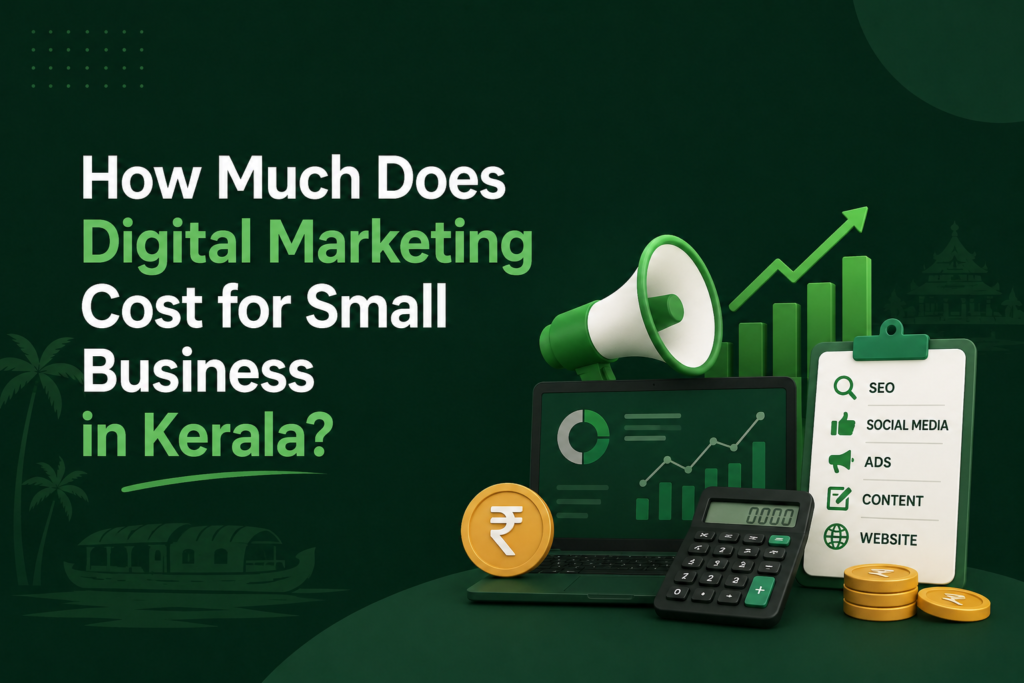
A business might need one service or a combination of several activities, such as:
- Search engine optimisation
- Social media marketing
- Content creation
- Google Ads
- Meta Ads
- Website development
- Email marketing
- Lead generation
- Analytics and reporting
- Conversion optimisation
A small business that only needs social media management will naturally have different requirements from an e-commerce brand running paid advertising, SEO, content marketing, and email campaigns together.
This is why comparing two digital marketing packages only by their monthly price can sometimes be misleading.
Typical Digital Marketing Costs for Small Businesses
For small businesses in Kerala, monthly digital marketing costs can vary considerably depending on the scope of work.
A basic social media management package may start from a relatively modest monthly amount, while a more comprehensive strategy involving SEO, content, paid advertising, analytics, and regular optimisation can cost significantly more.
As a broad planning reference, businesses may encounter monthly service charges ranging from around ₹5,000 to ₹50,000+, depending on the services and level of expertise involved.
This range should not be treated as a standard market rate. It is simply a way to understand how widely digital marketing requirements can differ.
There is also an important distinction between marketing service fees and advertising spend.
If a business pays a marketer ₹15,000 for campaign management and separately spends ₹20,000 on advertisements, the total monthly marketing investment is ₹35,000.
The two amounts serve different purposes.
Service Fee vs Advertising Budget
This is one of the most important things a business owner should understand.
Service Fee
This is the amount paid to the freelancer, consultant, or agency for the work involved.
It may cover activities such as:
- Campaign planning
- Keyword research
- Audience research
- Ad setup
- Content planning
- Campaign optimisation
- SEO work
- Reporting
- Strategy
- Account management
Advertising Budget
This is the actual amount allocated to platforms such as Google or Meta to display advertisements.
For example:
Marketing management: ₹15,000/month
Advertising budget: ₹20,000/month
The total investment would be ₹35,000, but only ₹15,000 is the service fee.
Understanding this difference helps businesses compare proposals more accurately.
How Much Should a Small Business Spend?
There is no universal percentage or amount that every business should spend.
The right budget depends on the business objective.
A newly launched local business may initially want to build awareness and generate enquiries. An established e-commerce business may be more focused on increasing online purchases.
The expected customer value also matters.
Suppose a business sells a ₹500 product with a small profit margin. Its advertising economics will be very different from a business selling a service worth ₹50,000.
Therefore, the budget should be considered alongside:
Customer acquisition cost + profit margin + customer lifetime value + conversion rate.
Simply choosing a budget because another business is spending the same amount does not make much sense.
What Determines the Cost of Digital Marketing?
Several factors influence the final price.
- Number of Services
Managing one channel requires less work than managing multiple channels.
SEO, social media, paid advertising, content creation, and email marketing each require different skills and ongoing effort.
- Content Requirements
A business that needs frequent reels, graphics, photographs, videos, captions, and blogs will generally require more resources than one that already has its content prepared.
- Advertising Spend
Paid campaigns require a separate media budget.
The more campaigns, audiences, locations, and products being managed, the more complex the work can become.
- Competition
Highly competitive industries may require more research, testing, optimisation, and creative experimentation.
For example, businesses competing for the same customers in a crowded local market may need a stronger strategy than businesses operating in a less competitive niche.
- Business Goals
Generating 20 qualified enquiries is a different objective from generating thousands of website visits.
The more specific and demanding the goal, the more strategic planning may be required.
Why Very Cheap Packages May Not Always Be Better
Price is important, particularly for small businesses.
But the cheapest option is not automatically the most cost-effective option.
Imagine paying a very low monthly fee for someone to publish a few generic posts without understanding your audience, tracking conversions, analysing performance, or improving the strategy.
The business may technically be “doing digital marketing,” but there may be little connection between the activity and actual business growth.
A better question is not:
“Who offers the cheapest package?”
Instead, ask:
“What exactly am I getting, and how does it contribute to my business objective?”
What Should You Ask Before Hiring a Digital Marketer?
Before choosing a freelancer or agency, a business owner should understand what is included.
Some useful questions are:
- What services are included?
- Is advertising spend separate?
- How often will campaigns be reviewed?
- What metrics will be reported?
- Who creates the content?
- Is SEO included?
- How are leads or conversions tracked?
- What happens if the strategy is not performing?
- Is there a minimum contract period?
- What access will the business owner have to advertising accounts and analytics?
Clear answers can prevent misunderstandings later.
Should You Start With a Small Budget?
For many small businesses, starting with a manageable budget can be sensible.
Digital marketing involves testing.
An initial campaign can provide information about which audiences respond, which messages attract attention, which products perform better, and where customers drop out of the buying process.
That information can then be used to make better decisions.
Instead of putting a large amount of money into an untested strategy, businesses can begin with a realistic budget, measure the results, learn from the data, and gradually increase investment when the numbers justify it.
Focus on Return, Not Just Cost
A ₹10,000 marketing investment is not necessarily expensive if it generates ₹50,000 in profitable revenue.
Similarly, ₹5,000 can be expensive if it produces no meaningful business outcome.
This is why digital marketing should ultimately be evaluated based on the value it creates.
Metrics such as leads, qualified enquiries, sales, customer acquisition cost, conversion rate, and return on advertising spend can provide a much clearer picture than simply looking at the monthly fee.
Final Thoughts
Digital marketing costs for small businesses in Kerala can vary widely because every business has different goals, customers, competition, and requirements.
A local business may need a simple combination of social media and search advertising, while another business may require a complete strategy covering SEO, paid campaigns, content, website optimisation, and analytics.
There is no magic monthly amount that guarantees results.
The better approach is to start with a clear business objective, understand which marketing activities can support that objective, set a realistic budget, and continuously measure what happens.
For a small business, the goal should not simply be to spend less on digital marketing.
It should be to make every part of the marketing investment purposeful, measurable, and connected to business growth.