Search is changing faster than ever. For years, businesses focused on traditional search engine optimization (SEO) to appear on Google’s first page. Keywords, backlinks, technical SEO, and optimized content were the main pillars of search visibility.
But today, people are increasingly using AI-powered search experiences to find information. Instead of clicking through several websites, users can ask a question and receive a summarized answer generated by artificial intelligence. This shift is changing how people discover brands, products, and information online.
AI Overviews, ChatGPT, Gemini, and other AI-powered search experiences are creating a new search environment. As a result, businesses can no longer focus only on ranking a webpage. They also need to think about how their content can become a reliable source for AI-generated answers.
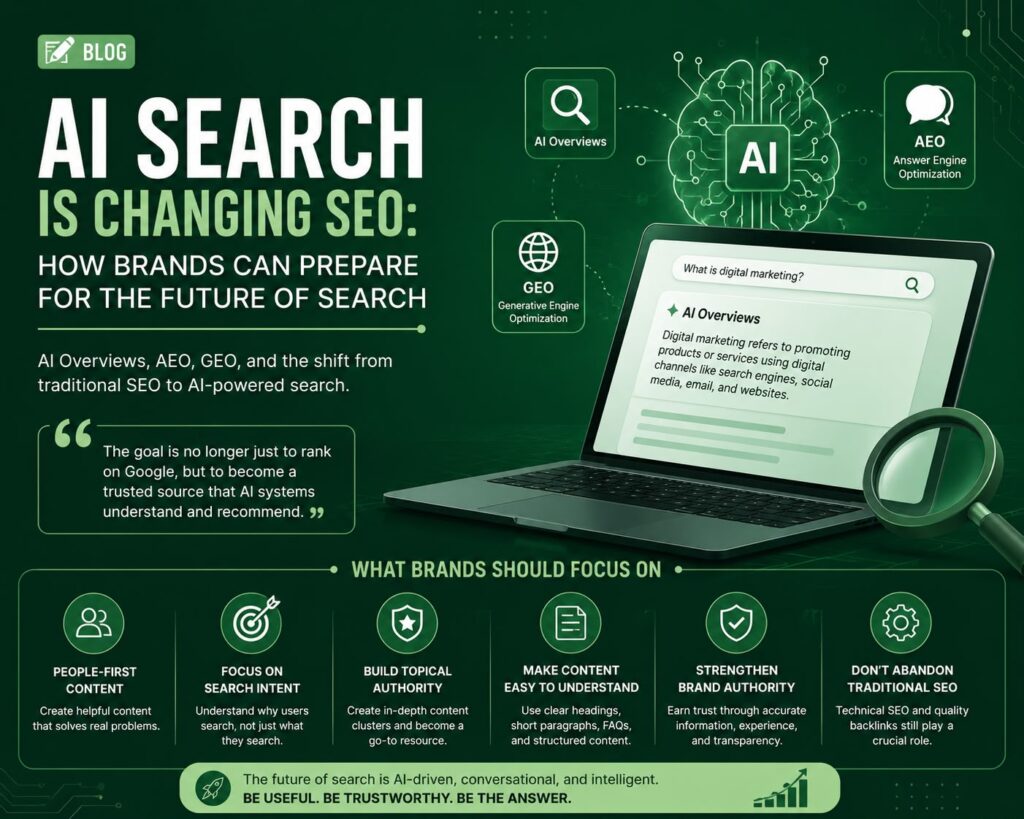
This is where concepts such as Answer Engine Optimization (AEO) and Generative Engine Optimization (GEO) are becoming increasingly important.
The Shift from Traditional Search to AI Search
Traditional search usually works around a simple process: a user enters a query, search engines display relevant webpages, and the user chooses which result to visit.
For example, someone searching for “best digital marketing strategies for small businesses” may see a list of websites, blogs, videos, and other resources.
AI-powered search changes this experience. Instead of simply presenting links, AI can understand the question, combine information from different sources, and provide a direct answer.
This means the goal of SEO is gradually expanding.
Earlier, brands mainly asked:
“How can I rank higher on Google?”
Now they also need to ask:
“How can my brand become a trusted source that AI systems recognize and recommend?”
What Are AI Overviews?
AI Overviews are AI-generated summaries that appear within search experiences for certain queries. They are designed to give users a quick understanding of a topic without requiring them to open multiple webpages.
For businesses, this creates both an opportunity and a challenge.
A brand that gets referenced in an AI-generated answer can potentially gain visibility and credibility. However, users may also get the information they need without clicking on the traditional search results.
Therefore, businesses need to create content that is useful enough to be considered a valuable source, not just content written to manipulate rankings.
Understanding AEO
Answer Engine Optimization (AEO) focuses on optimizing content so that it can provide direct answers to users’ questions.
Instead of targeting only short keywords, AEO focuses on search intent and conversational questions.
For example, instead of targeting only:
“Google Ads”
a business could create content around questions such as:
- What is Google Ads?
- How does Google Ads work?
- How much does Google Ads cost?
- Is Google Ads suitable for small businesses?
- How can a business improve its Google Ads performance?
This approach helps brands create content that directly addresses what people are actually looking for.
Clear headings, concise answers, FAQs, structured content, and accurate information can all contribute to a stronger AEO strategy.
What Is GEO?
Generative Engine Optimization (GEO) focuses on improving a brand’s visibility within AI-generated responses.
While SEO focuses heavily on search engine rankings, GEO considers how generative AI systems understand, evaluate, and potentially mention information about a brand.
For example, imagine someone asks an AI tool:
“What are some good digital marketing agencies for small businesses?”
A business would want its brand to be recognized as a relevant and trustworthy option when the AI generates its response.
This makes brand authority increasingly important.
Businesses should therefore focus on publishing accurate, useful, original, and well-supported content across their digital presence.
Traditional SEO vs AI Search
Traditional SEO is not becoming useless. Instead, it is becoming one part of a broader search strategy.
Traditional SEO focuses on areas such as:
- Keyword research
- Search intent
- Technical SEO
- Backlinks
- Website structure
- On-page optimization
- Page experience
AI-focused search optimization adds more emphasis on:
- Direct answers
- Conversational queries
- Topical authority
- Brand mentions
- Structured information
- First-hand expertise
- Trust and credibility
- Content that can be easily understood and summarized
The important point is that SEO and AEO/GEO should not be treated as completely separate strategies.
Strong technical SEO helps search engines discover and understand a website. High-quality content helps users find value. Clear and authoritative information can also make content more useful within AI-powered search experiences.
How Brands Can Prepare for the Future
- Create Helpful, People-First Content
Brands should stop creating content simply to target keywords.
Instead, content should solve real problems.
A useful blog should answer the reader’s question, provide practical information, and demonstrate genuine knowledge of the subject.
Quality should always come before keyword stuffing.
- Focus on Search Intent
Understanding why someone is searching is more important than simply identifying a keyword.
A person searching for “best running shoes” may be looking for recommendations, while someone searching for “how to choose running shoes” may want educational information.
Understanding these differences allows brands to create content that matches the user’s actual needs.
- Build Topical Authority
Publishing one article about a topic is not always enough.
Brands can create multiple useful pieces of content around a particular subject and connect them through internal links.
For example, a digital marketing website could create content about SEO, Google Ads, Meta Ads, content marketing, analytics, and conversion optimization.
Over time, this creates a stronger topical ecosystem.
- Make Content Easy to Understand
AI systems and users both benefit from clear information.
Use descriptive headings, short paragraphs, bullet points, definitions, examples, and FAQs where appropriate.
Instead of hiding the main answer inside a long introduction, provide a clear answer first and explain it in more detail afterward.
- Strengthen Brand Authority
AI search makes brand reputation increasingly important.
Businesses should maintain accurate information across their website and other trustworthy online platforms.
Publishing original research, expert insights, case studies, customer experiences, and useful resources can help establish authority.
- Don’t Abandon Traditional SEO
The rise of AI search does not mean businesses should stop doing SEO.
Technical SEO, mobile optimization, internal linking, page speed, crawlability, metadata, and quality backlinks still matter.
The better approach is to combine traditional SEO with AEO and GEO.
The Future of Search
The future of search is likely to become more conversational and personalized.
People may not always search using short keywords. Instead, they may ask detailed questions just as they would ask another person.
For brands, this means content strategies need to evolve.
The winning approach will not simply be about producing more content. It will be about producing better, clearer, more trustworthy, and more useful content.
Businesses that understand this shift early can build a stronger digital presence while others are still focusing only on traditional rankings.
Conclusion
AI is changing the way people discover information online, but SEO is not disappearing. It is evolving.
Traditional SEO helps search engines discover and rank content. AEO helps brands provide direct answers to users. GEO focuses on visibility within generative AI experiences.
The future belongs to brands that can combine all three approaches.
Instead of asking only, “How do I rank on Google?”, marketers should start asking:
“How can I become the most useful and trustworthy source for my audience—wherever they search?”
That mindset is the foundation of future-ready search marketing.