How to Choose the Right Digital Marketing Strategy for Your Business
Digital marketing can mean different things to different businesses.
For one business, it may mean generating leads through Google Ads. For another, it may mean building a strong presence on Instagram. An e-commerce brand may focus heavily on paid advertising and conversion optimisation, while a local service business may get better results from search visibility and location-based marketing.
This is why there is no single digital marketing strategy that works for every business.
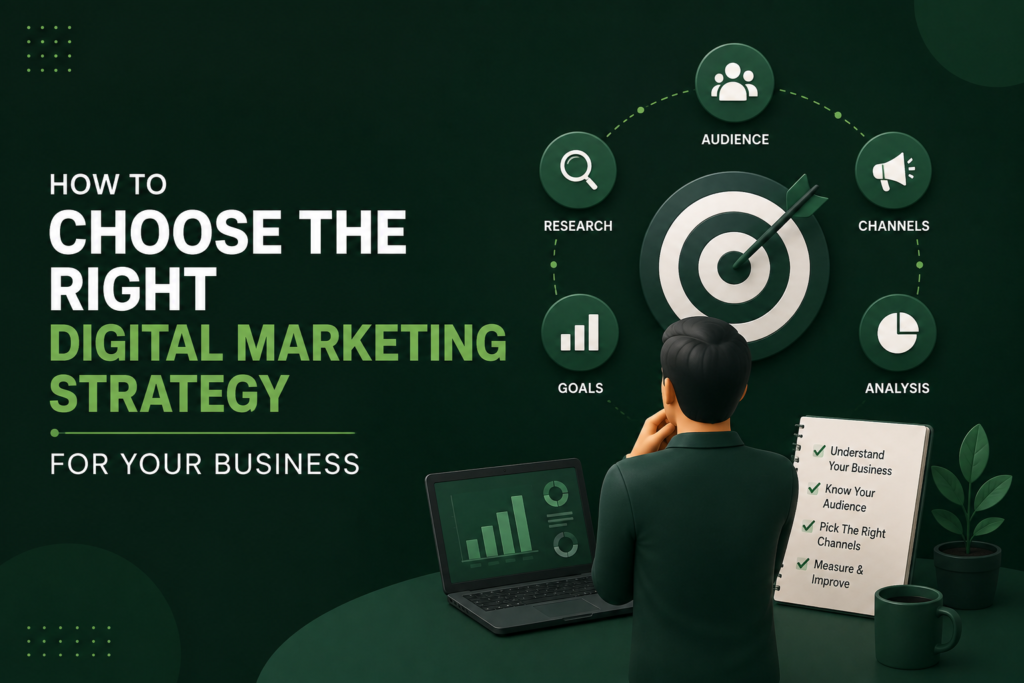
The right strategy starts with understanding the business itself: its customers, goals, products, competition, budget, and buying journey.
Instead of trying to be present on every platform, businesses should identify the channels and activities that have the strongest connection to their actual objectives.
Start With Your Business Goal
The first question should not be:
“Which social media platform should I use?”
It should be:
“What do I want my marketing to achieve?”
Different goals require different approaches.
A business might want to:
- Increase online sales
- Generate more enquiries
- Build brand awareness
- Attract local customers
- Increase website traffic
- Launch a new product
- Improve customer retention
- Build long-term organic visibility
For example, a business focused on immediate lead generation may prioritise paid advertising and conversion-focused landing pages.
A new brand trying to become recognisable may need to invest more heavily in content, social media, and brand communication.
Without a clear objective, it becomes difficult to decide where the marketing budget should go.
Understand Who Your Customers Are
A strategy should be built around the customer, not the platform.
Before choosing marketing channels, understand who is most likely to buy from you.
Think about:
- Who is your ideal customer?
- Where do they live?
- What problem are they trying to solve?
- What influences their buying decision?
- How do they search for products or services?
- What questions do they ask before purchasing?
- How long does it usually take them to make a decision?
A customer looking for an emergency service behaves differently from someone researching a product they may purchase several weeks later.
Understanding this buying behaviour helps determine which marketing channels are worth prioritising.
Look at the Customer Journey
Customers rarely move directly from seeing a brand to making a purchase.
They may first discover a business through social media, search for it later on Google, visit the website, compare alternatives, and eventually make an enquiry or purchase.
This journey can be divided broadly into stages:
Awareness → Consideration → Conversion → Retention
Different marketing activities can support different stages.
Social media content can introduce a brand.
SEO can help people discover useful information through search.
Paid advertising can capture existing demand or create targeted awareness.
Email or WhatsApp communication can help maintain relationships with existing customers.
A strong strategy connects these activities instead of treating them as completely separate tasks.
Choose Channels Based on Your Audience
Not every business needs to be active everywhere.
A business should choose platforms based on where its potential customers actually spend time and how they make purchasing decisions.
Search Marketing
Search marketing can be valuable when customers actively look for products, services, information, or solutions.
SEO can help businesses build long-term organic visibility, while search advertising can provide paid visibility for relevant searches.
This can be particularly useful for businesses where customers already have a clear intention.
Social Media Marketing
Social media can be useful for building awareness, creating conversations, showcasing products, and developing a recognisable brand identity.
Instagram, Facebook, LinkedIn, and other platforms can serve different audiences and purposes.
The objective should determine the platform rather than the other way around.
Content Marketing
Content can answer customer questions, demonstrate expertise, explain products, and support both search visibility and brand credibility.
Blogs, videos, guides, case studies, carousels, and other formats can become useful assets over time.
Good content should have a purpose. Publishing simply because a content calendar says “post today” is not necessarily a strategy.
Consider Performance Marketing When Results Need to Be Measurable
For businesses that want measurable actions from their digital campaigns, performance marketing can become an important part of the strategy.
Instead of focusing only on visibility, campaigns can be designed around measurable outcomes such as:
- Leads
- Website conversions
- Purchases
- Bookings
- Enquiries
- App installations
Platforms such as Google Ads and Meta Ads can be used depending on the objective and customer journey.
For example, Google Ads can help capture people who are actively searching for a relevant product or service.
Meta advertising can help businesses reach potential customers through visually engaging content and targeted campaigns.
The important part is not simply running advertisements. Tracking, testing, analysing, and optimising the campaigns are what make performance marketing useful.
Don’t Forget Your Website
Your website is often the place where different marketing channels come together.
Someone may discover your business through Instagram, Google, a blog post, or an advertisement and eventually arrive at your website.
If the website is difficult to use, slow, confusing, or unclear about what the visitor should do next, marketing efforts can lose their effectiveness.
A good website should communicate:
- What the business offers
- Who it serves
- Why customers should choose it
- What makes it different
- How to take the next step
For service businesses, this could mean making an enquiry.
For an e-commerce business, it could mean completing a purchase.
For a local business, it might mean calling, booking, or visiting the location.
Study Your Competition — But Don’t Copy Them
Competitor research can reveal useful information.
Look at how similar businesses position themselves, what topics they talk about, what type of content they create, what offers they promote, and how their websites are structured.
But copying a competitor’s strategy rarely creates a strong brand.
Instead, identify gaps.
Maybe competitors provide generic content while your business can offer more useful guides.
Maybe their websites are difficult to navigate.
Maybe they focus heavily on discounts while your brand can compete through expertise, service, convenience, or customer experience.
Competitive research should help you find opportunities, not make your business look identical to everyone else.
Set a Realistic Marketing Budget
A digital marketing strategy should match the resources available.
A small business does not necessarily need to invest in five different channels immediately.
It may be more effective to choose one or two high-potential channels, build a strong foundation, measure the results, and expand gradually.
Budget should also be divided thoughtfully between different activities.
For example, paid advertising requires media spend, while SEO requires ongoing content and optimisation work.
Understanding these differences makes it easier to create realistic expectations.
Measure What Actually Matters
One of the biggest mistakes businesses make is measuring activity instead of outcomes.
Followers, likes, impressions, and website visits can provide useful information, but they do not always represent business growth.
Depending on your objective, you may want to track:
- Qualified leads
- Sales
- Conversion rate
- Cost per lead
- Customer acquisition cost
- Revenue
- Return on advertising spend
- Organic search growth
- Repeat purchases
The most important metrics are the ones connected to your business objective.
Test Before Scaling
A strategy does not need to be perfect from day one.
Digital marketing provides an opportunity to experiment.
You can test different audiences, messages, creatives, landing pages, offers, keywords, and content formats.
The results can then guide future decisions.
If one campaign consistently produces better-quality leads, the strategy can be adjusted accordingly.
If a particular content format performs well, more resources can be allocated to it.
This makes marketing an ongoing learning process rather than a one-time activity.
Build a Strategy That Can Evolve
Customer behaviour changes.
Platforms change.
Competition changes.
New technologies and advertising formats appear.
A digital marketing strategy therefore should not be treated as a fixed document that never changes.
Review performance regularly and ask:
What is working?
What is not working?
What has changed?
What should we test next?
This simple process can prevent businesses from continuing to spend time and money on activities that no longer contribute to their goals.
Final Thoughts
Choosing the right digital marketing strategy is not about being present on every platform or following the latest trend.
It is about creating a clear connection between business goals, customer needs, marketing channels, and measurable outcomes.
Start by understanding what the business wants to achieve. Then study the customer, map their buying journey, choose the most relevant channels, create useful content, use paid campaigns where they make sense, and measure the results.
Most importantly, give the strategy enough flexibility to learn and improve.
The best digital marketing strategy is rarely the one that does the most things.
It is the one that focuses on the right things for the right audience at the right stage of the customer journey.