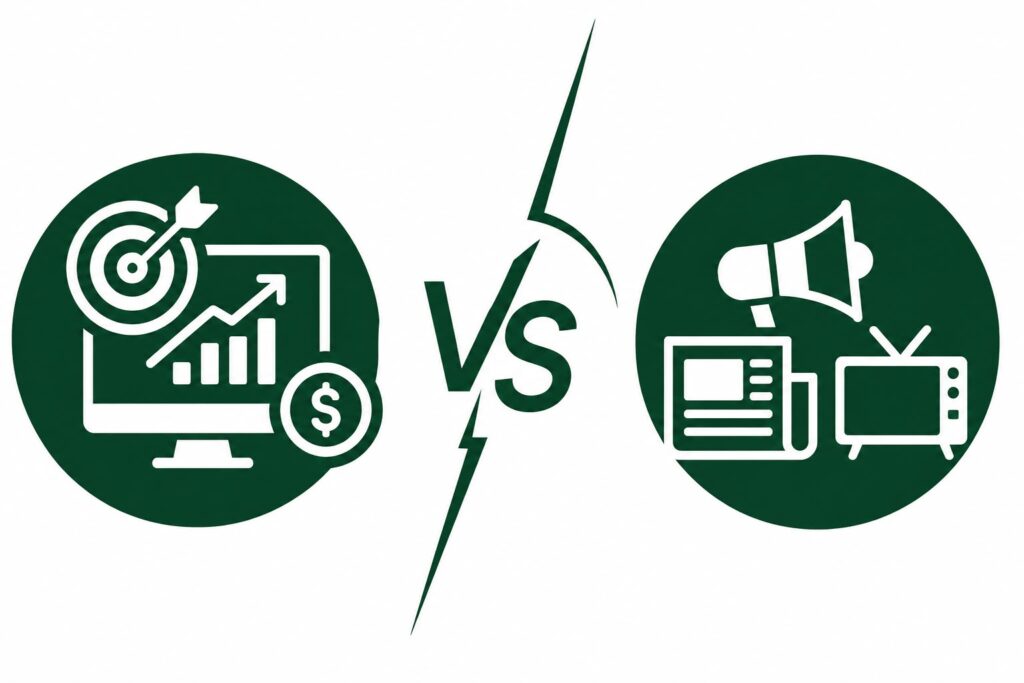
In today’s competitive business landscape, marketing is no longer just about getting your brand noticed—it’s about achieving measurable results. Businesses now have more marketing options than ever before, but one common question remains: Should you invest in performance marketing or traditional marketing?
While traditional marketing has helped brands build awareness for decades, performance marketing has transformed the way businesses reach customers by focusing on measurable outcomes. Understanding the differences between these two approaches can help you choose the right strategy for your business goals.
In this blog, we’ll compare performance marketing vs traditional marketing, highlighting their advantages, disadvantages, and when to use each.
What is Traditional Marketing?
Traditional marketing refers to promotional methods that existed before the rise of digital platforms. These include:
- Television advertisements
- Radio commercials
- Newspaper ads
- Magazine advertisements
- Billboards
- Flyers and brochures
- Direct mail
The primary objective of traditional marketing is to increase brand awareness among a large audience.
For example, a local restaurant placing a billboard on a busy highway hopes that thousands of people passing by will notice the advertisement and eventually visit the restaurant.
Traditional marketing focuses more on exposure than measurable conversions.
What is Performance Marketing?
Performance marketing is a digital marketing strategy where businesses pay only when a specific action occurs.
These actions may include:
- Website visits
- Leads
- Purchases
- App installs
- Form submissions
- Phone calls
Unlike traditional advertising, performance marketing provides real-time analytics that allow marketers to track every rupee spent and every result generated.
Popular performance marketing channels include:
- Google Ads
- Meta Ads (Facebook & Instagram)
- LinkedIn Ads
- YouTube Ads
- Affiliate Marketing
- Native Advertising
The biggest advantage is accountability. Every campaign can be optimized based on actual performance data.
Performance Marketing vs Traditional Marketing
1. Cost Structure
Traditional marketing usually requires businesses to pay upfront regardless of the campaign’s outcome.
For instance, a television commercial costs the same whether it generates ten customers or ten thousand.
Performance marketing works differently.
Businesses only pay when predefined actions occur, making it much more budget-friendly, especially for small businesses and startups.
Winner: Performance Marketing
2. Audience Targeting
Traditional marketing targets a broad audience.
A newspaper advertisement reaches everyone reading that newspaper, regardless of whether they’re interested in the product.
Performance marketing allows highly specific targeting based on:
- Age
- Gender
- Location
- Interests
- Online behavior
- Purchase intent
- Device type
This ensures marketing budgets are spent reaching people who are more likely to become customers.
Winner: Performance Marketing
3. Measurability
One of the biggest challenges with traditional marketing is measuring effectiveness.
Did a customer visit because of a billboard?
Was it because of a newspaper ad?
Often, businesses can only estimate.
Performance marketing provides detailed metrics including:
- Clicks
- Impressions
- Cost per Click (CPC)
- Cost per Lead (CPL)
- Conversion Rate
- Return on Ad Spend (ROAS)
- Revenue Generated
Every campaign can be tracked in real time.
Winner: Performance Marketing
4. Campaign Optimization
Traditional advertisements cannot easily be modified after launch.
If a newspaper ad contains an ineffective message, businesses have to wait for the next edition.
Digital performance campaigns can be optimized instantly.
Marketers can:
- Change headlines
- Replace images
- Adjust budgets
- Pause underperforming ads
- Test multiple creatives
- Improve targeting
Continuous optimization leads to better campaign performance.
Winner: Performance Marketing
5. Speed of Results
Traditional marketing often takes weeks or months to show measurable business impact.
Performance marketing can start generating website traffic, leads, or sales within hours of launching a campaign.
Businesses can quickly identify what’s working and scale successful campaigns.
Winner: Performance Marketing
6. Brand Awareness
Traditional marketing still has a significant advantage when it comes to mass brand awareness.
Large companies often use television commercials, outdoor advertising, and print media to build trust and recognition.
A memorable TV campaign can influence millions of people simultaneously.
Performance marketing also supports brand awareness but typically focuses more on measurable customer actions.
Winner: Traditional Marketing
7. Customer Engagement
Traditional marketing is mostly one-way communication.
Customers simply view or hear advertisements.
Performance marketing encourages interaction through:
- Comments
- Shares
- Likes
- Website visits
- Live chats
- Lead forms
- Direct messages
This creates stronger relationships with potential customers.
Winner: Performance Marketing
Advantages of Traditional Marketing
Traditional marketing remains valuable because it:
- Builds strong brand credibility
- Reaches offline audiences
- Creates memorable large-scale campaigns
- Works well for local community promotions
- Is trusted by older demographics
Large brands often combine traditional media with digital campaigns for maximum reach.
Advantages of Performance Marketing
Performance marketing offers numerous benefits, including:
- Better return on investment
- Real-time campaign monitoring
- Precise audience targeting
- Flexible budgets
- Faster optimization
- Measurable results
- Data-driven decision-making
- Higher conversion rates
Businesses can continually improve campaigns using analytics instead of relying on assumptions.
Which Marketing Strategy is Right for Your Business?
The answer depends on your business objectives.
Choose Traditional Marketing if you want to:
- Increase mass brand awareness
- Reach audiences with limited internet access
- Build long-term brand recognition
- Launch nationwide awareness campaigns
Choose Performance Marketing if you want to:
- Generate qualified leads
- Increase online sales
- Maximize advertising ROI
- Track every marketing expense
- Scale campaigns using data
- Reach highly targeted audiences
For most small and medium-sized businesses, performance marketing provides greater flexibility and measurable growth.
Can You Combine Both?
Absolutely.
Many successful businesses use an integrated marketing strategy.
For example:
- A television advertisement creates brand awareness.
- Google Ads capture people searching for the brand.
- Meta Ads retarget website visitors.
- Email marketing nurtures leads.
- Performance analytics optimize future campaigns.
This combination helps businesses build awareness while driving measurable conversions.
Final thoughts
Both traditional marketing and performance marketing have their strengths. Traditional marketing excels at building broad brand recognition and trust, while performance marketing focuses on measurable outcomes, precise targeting, and maximizing return on investment.
As consumers increasingly spend more time online, businesses that rely on data-driven marketing strategies are better positioned to adapt, optimize, and grow. Performance marketing allows companies to monitor results in real time, make informed decisions, and continuously improve campaign performance.
Rather than viewing the two approaches as competitors, consider how they can complement each other. A balanced marketing strategy that combines the wide reach of traditional marketing with the precision and accountability of performance marketing can help businesses achieve both long-term brand growth and immediate business results.
By understanding your audience, setting clear goals, and choosing the right mix of marketing channels, you can create campaigns that not only attract attention but also deliver measurable success.