Google Ads has become one of the most effective ways for businesses to reach potential customers online. Whether you own a local business, run an e-commerce store, or offer professional services, Google Ads helps you connect with people who are actively searching for what you provide.
But simply launching a campaign isn’t enough. Many businesses invest money in Google Ads expecting instant results, only to be disappointed when they don’t see enough leads or sales. In most cases, the problem isn’t the platform—it’s a few common mistakes that prevent campaigns from performing well.
The good news? These mistakes are easy to fix once you know what to look for.
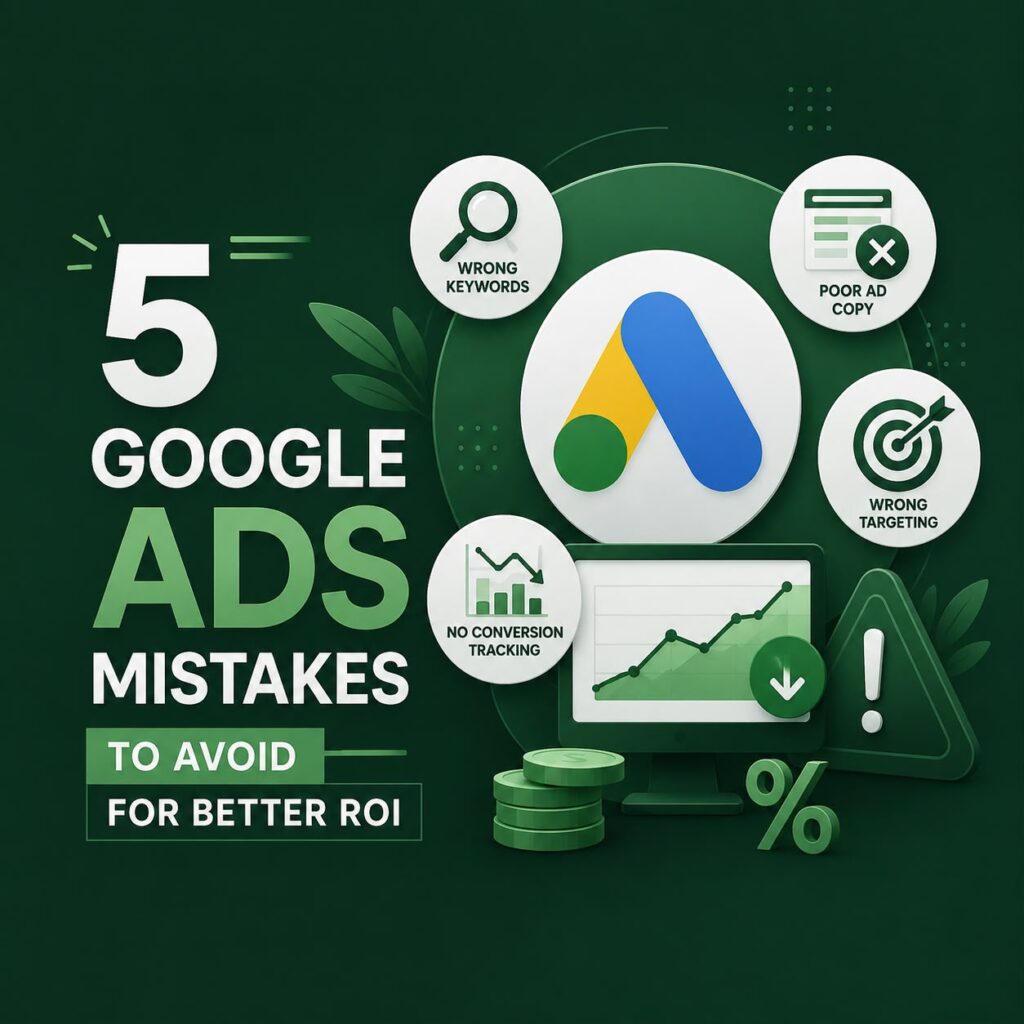
In this blog, we’ll discuss five common Google Ads mistakes that can waste your advertising budget and, more importantly, how you can avoid them to improve your campaign performance and get a better return on investment (ROI).
1. Choosing the Wrong Keywords
Every successful Google Ads campaign starts with the right keywords. These are the words and phrases people type into Google when they’re looking for a product or service.
A common mistake many beginners make is choosing keywords that are too broad. While broad keywords can generate a lot of traffic, they don’t always bring the right audience.
For example, imagine you own a premium furniture store. If you target the keyword “chairs,” your ad could appear for searches like:
- Plastic chairs
- Office chairs
- Used chairs
- Chair repair
Most of these people aren’t looking for the products you sell, so you’re paying for clicks that are unlikely to become customers.
How to Avoid This Mistake
Instead of broad keywords, focus on keywords that clearly reflect what you offer.
For example:
❌ Digital Marketing
✅ Google Ads Management Services
✅ Performance Marketing Agency
✅ Google Ads Expert for Small Businesses
Long-tail keywords usually have lower competition and attract people who are closer to making a purchase.
Also, spend time researching keywords using Google Keyword Planner and regularly review your Search Terms Report to discover new opportunities.
2. Forgetting to Use Negative Keywords
Negative keywords are one of the easiest ways to reduce wasted ad spend, yet many advertisers overlook them.
Negative keywords tell Google when not to show your ads.
Let’s say you provide paid digital marketing services. You probably don’t want your ads appearing when someone searches for
- Free digital marketing course
- Marketing jobs
- Internship opportunities
- Marketing salary
These users aren’t looking to hire a marketer—they’re looking for information or employment.
Without negative keywords, you’ll continue paying for irrelevant clicks.
How to Avoid This Mistake
Create a list of words that don’t match your business, such as:
- Free
- Jobs
- Career
- Internship
- Course
- Tutorial
Make it a habit to review your Search Terms Report every week and keep adding irrelevant terms to your negative keyword list.
This simple step can save a significant portion of your advertising budget.
3. Sending Visitors to a Poor Landing Page
Getting someone to click on your ad is only half the job. What happens after they click is just as important.
Many businesses spend thousands on Google Ads but direct visitors to a generic homepage instead of a dedicated landing page. If users can’t quickly find what they’re looking for, they’ll leave within seconds.
Imagine clicking an ad for Google Ads Management Services and landing on a homepage filled with unrelated information. Most visitors won’t spend time searching—they’ll simply close the page and move on.
That’s why your landing page should match the promise made in your advertisement.
A good landing page should include the following:
- A clear and engaging headline
- Information that matches the ad
- A strong call-to-action (CTA)
- Fast loading speed
- Mobile-friendly design
- Customer testimonials or reviews
- Easy-to-find contact details or enquiry form
A well-designed landing page not only improves conversions but can also improve your Google Ads quality score.
4. Not Tracking Conversions
Many advertisers focus only on clicks and impressions. While these numbers look impressive, they don’t tell you whether your ads are actually generating business.
Imagine receiving 2,000 clicks in a month. That sounds great—but what if none of those visitors contacted you or made a purchase?
Without conversion tracking, it’s impossible to know what’s working.
You won’t know:
- Which keywords generate leads
- Which ads drive sales
- Which audience performs best
- How much each conversion costs
- Whether you’re making a profit
How to Avoid This Mistake
Set up Google Ads Conversion Tracking and connect your account with Google Analytics 4 (GA4).
Track important actions such as:
- Contact form submissions
- Phone calls
- Online purchases
- Newsletter subscriptions
- Downloads
Once you have accurate data, you can confidently invest more in campaigns that generate results and pause those that don’t.
5. Setting Up Campaigns and Forgetting About Them
One of the biggest misconceptions about Google Ads is that campaigns will keep performing well without any maintenance.
In reality, Google Ads requires regular monitoring and optimization.
Consumer behavior changes, competitors adjust their campaigns, and search trends evolve. If you don’t keep improving your campaigns, performance will gradually decline.
Successful advertisers constantly test and refine their campaigns.
Things You Should Optimize Regularly
- Headlines
- Ad descriptions
- Keywords
- Bidding strategy
- Budget allocation
- Audience targeting
- Device performance
- Geographic locations
Even small improvements can significantly increase click-through rates and conversions over time.
Google Ads rewards advertisers who continuously optimize their campaigns.
Bonus Tips for Better Google Ads Results
If you want to get even better results from your campaigns, keep these best practices in mind:
- Write ad copy that focuses on customer benefits rather than features.
- Use ad extensions like sitelinks, callouts, and structured snippets to increase visibility.
- Improve your quality score by keeping your keywords, ads, and landing pages closely aligned.
- Make sure your website loads quickly on both desktop and mobile devices.
- Review campaign performance every week instead of waiting until your budget is exhausted.
- Test different versions of your ads to see what performs best.
Remember, Google Ads isn’t about setting up one campaign and hoping for the best. It’s about testing, learning, and improving over time.
Why Avoiding These Mistakes Is Important
Google Ads has the potential to become one of the most profitable marketing channels for your business—but only if it’s managed correctly.
By avoiding these common mistakes, you can:
- Reduce wasted advertising spend
- Improve your click-through rate (CTR)
- Increase your Quality Score
- Lower your cost per click (CPC)
- Generate better-quality leads
- Increase conversions
- Maximize your return on investment (ROI)
Every improvement, no matter how small, contributes to better campaign performance in the long run.
Final thoughts
Google Ads is a powerful tool, but success doesn’t happen by chance. The difference between a campaign that wastes money and one that consistently generates leads often comes down to avoiding a few common mistakes.
Choosing the right keywords, using negative keywords effectively, creating high-converting landing pages, tracking conversions, and regularly optimizing your campaigns can make a huge difference in your results.
Think of Google Ads as an ongoing process rather than a one-time task. The more you monitor, test, and improve your campaigns, the better your results will become over time.
If you focus on these five areas, you’ll not only make better use of your advertising budget but also build campaigns that consistently bring in qualified leads, higher conversions, and sustainable business growth.